PregBiotics Reviews: How to Read Mother Experiences Wisely
Thinking about probiotics in pregnancy? Here's how to read PregBiotics reviews critically, spot red flags, and combine real mother feedback with evidence.
Dr. Chomba Chuma, MD & Founder
MD & Founder, PregBiotics

When you're expecting — or hoping to be — you quickly learn to Google everything twice. So it makes sense that before adding any new supplement to your routine, you go looking for pregbiotics reviews to see what other mothers actually experienced. That instinct is a good one. But reading reviews well is a skill, and in a category as sensitive as prenatal probiotics, it's worth doing properly.
This article isn't about telling you what to think of any single product. It's about giving you a framework — the same one I use with patients — for separating genuinely useful feedback from noise, marketing spin, or wishful thinking dressed up as evidence.
Why Mothers Search PregBiotics Reviews Before Trying Anything New
Pregnancy and the postpartum period are times of heightened caution, and rightly so. You're no longer making decisions for one body alone.
Research on health information-seeking consistently shows that pregnant women turn to peer reviews and forums specifically because they want to hear from someone who has "been there" — not just a product description written by a marketing team. That's a reasonable response to feeling vulnerable to overclaiming in the supplement industry.
But reviews have a particular psychology. People are more likely to leave a review when something goes dramatically well or dramatically wrong, which skews what you see. Understanding this bias is the first step to reading pregbiotics reviews — or reviews of any prenatal supplement — more usefully.
What Real Mothers Report in PregBiotics Reviews (And What to Take With a Grain of Salt)
Across reviews of probiotic supplements aimed at pregnancy and breastfeeding, a few recurring themes tend to show up:
- Improved regularity and less bloating within the first few weeks
- A sense of "settling" in nausea, particularly when taken with food
- Easier transition postpartum, especially alongside breastfeeding
- Taste, capsule size, and ease of swallowing (a surprisingly common complaint)
- Price sensitivity relative to pharmacy-brand alternatives
What you'll rarely see — and should be suspicious of if you do — are claims of dramatic, population-wide outcomes like "cured my GBS" or "guaranteed easy birth." Gut support may help with comfort and digestive balance for many women, but individual bodies respond differently, and no honest review should promise a universal outcome.
"Individual responses to probiotic supplementation vary considerably depending on baseline gut microbiota, diet, and strain specificity — population-level claims should always be interpreted with caution." — adapted from guidance summarised in peer-reviewed probiotic research indexed on PubMed
This is exactly why one glowing (or scathing) testimonial shouldn't carry more weight in your decision than it deserves.
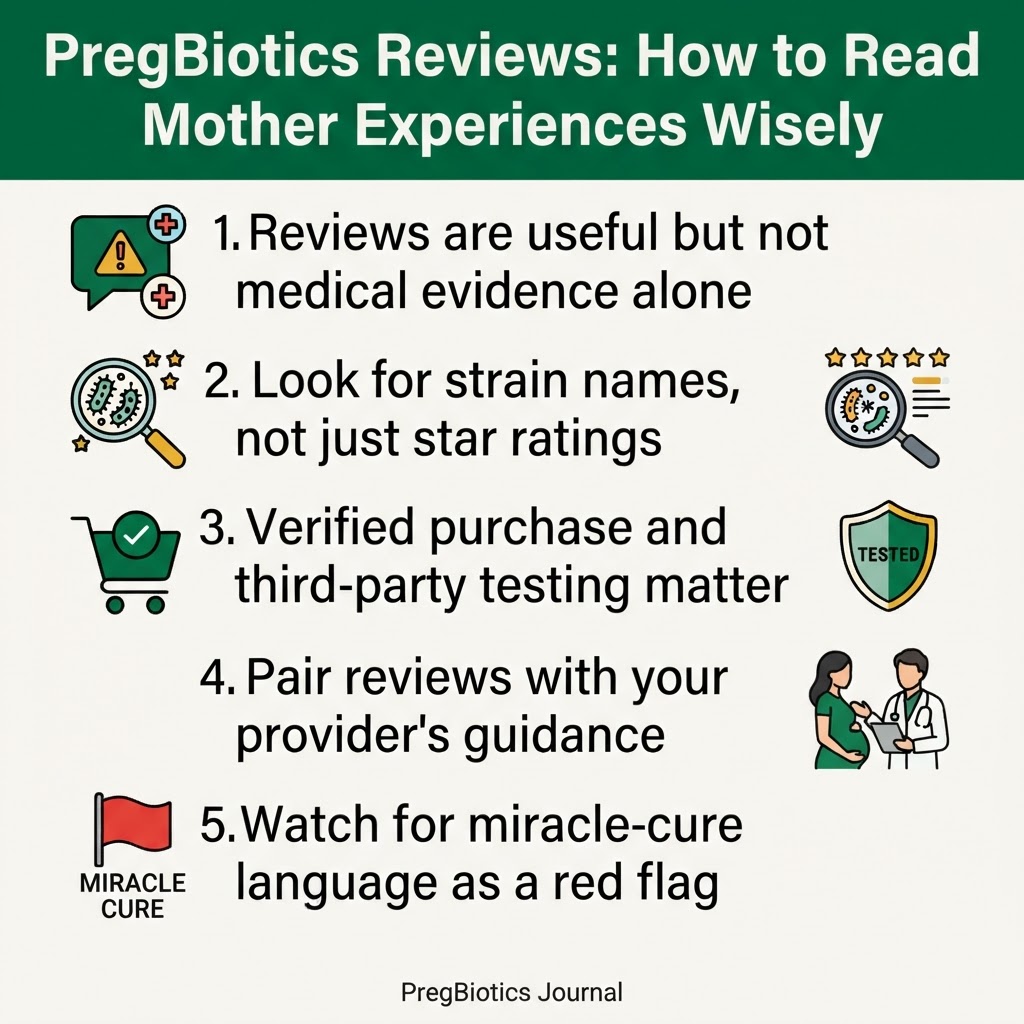
How to Read PregBiotics Reviews Like a Clinician Would
Here is the filter I'd encourage you to run every review through, whether it's for PregBiotics or any other prenatal probiotic.
1. Does the review mention specific strains?
A credible, detailed review will often reference strain names — things like Lactobacillus rhamnosus or Bifidobacterium lactis — rather than vague terms like "good bacteria." If a reviewer can speak to specifics, it suggests they engaged with the label, not just the packaging. Our guide on reading probiotic labels walks through exactly what to look for.
2. Is the timeframe realistic?
Gut changes don't happen overnight. A review claiming total transformation within two days should raise an eyebrow; most mothers report noticing differences in digestion over two to four weeks of consistent use.
3. Was it a verified purchase?
Platforms that verify purchases filter out a meaningful amount of incentivised or fake reviews. Always check for a "verified buyer" badge where available.
4. Does the reviewer mention speaking to a healthcare provider?
This might seem like an odd detail to look for, but it's often a marker of a thoughtful, safety-conscious reviewer — someone who treated the supplement as part of a broader care plan rather than a standalone fix.
What the Evidence Actually Says, Separate From Reviews
Reviews tell you about experience. They don't tell you about safety or mechanism — that's where clinical evidence comes in, and the two should be read together, not interchangeably.
The current body of research on probiotic use in pregnancy is reassuring on safety grounds for most healthy women, while being more modest about which specific outcomes are strongly supported.
"Probiotic and prebiotic supplements are generally regarded as low-risk for most pregnant women, but quality, strain selection, and individual health context should always be discussed with an obstetric provider before starting." — position reflected in guidance summarised by the National Center for Complementary and Integrative Health
If you want the deeper dive into what the research does and doesn't show, we've covered that thoroughly in Are Probiotics Safe in Pregnancy? What the Evidence Really Shows. That article is the evidence companion to this one; this one is about how to interpret what other mothers say alongside that evidence.
The World Health Organization also emphasises that maternal gut and nutritional health more broadly is associated with pregnancy outcomes — supporting the general principle behind gut-focused supplementation, even where specific probiotic claims require individual-level caution.
Red Flags in Any Probiotic Review Category
Whether you're reading pregbiotics reviews or reviews for a different brand entirely, watch for these patterns:
- Absolute language — words like "cure," "guarantee," or "instant fix" are inconsistent with how biology actually works
- No mention of a healthcare provider anywhere in a long, detailed review
- Suspiciously uniform wording across multiple reviews (a sign of incentivised or templated content)
- Claims about treating or preventing a diagnosed condition, such as GBS colonisation — gut support may be a helpful adjunct, but it is not a substitute for medical screening or treatment, which we detail in our GBS screening and prevention guide
- No negative reviews at all — a product with zero critical feedback across a large volume of reviews is statistically unusual and worth a second look
None of these automatically mean a product is bad. They just mean the review itself deserves more scrutiny before it shapes your decision.
Putting It All Together: A Simple Review-Reading Checklist
Before you let any single pregbiotics review — positive or negative — sway your decision, run through this short list:
- Does it mention specific strains or just vague "gut health" language?
- Is the timeframe for results realistic (weeks, not days)?
- Is it a verified purchase?
- Does the tone avoid absolute, miracle-style claims?
- Does the reviewer mention their healthcare provider or existing conditions?
- Are there a mix of positive and constructive reviews, not just five-star uniformity?
If a review checks most of these boxes, it's probably a genuinely useful data point. If it checks none of them, treat it as entertainment rather than evidence.
This same checklist applies well beyond supplements — it's a useful habit for any health-related purchase you make during pregnancy or postpartum, when you're more targeted by marketing than at almost any other life stage.
Your Next Step
The simplest way to form your own honest opinion is to start with full information: read the label, understand the strains, and have a short conversation with your healthcare provider about whether a prenatal probiotic fits your specific history. If you'd like a starting point built around transparency rather than hype, our PregBiotics Essentials formula lists every strain clearly so you can evaluate it the way we've described here — on substance, not just star ratings.
And if you'd like more guides like this one, delivered as new evidence and mother experiences come in, subscribe to the PregBiotics Journal — we write for mothers who want to think clearly, not just shop quickly.
Get the PregBiotics Journal in your inbox
Gut-smart guidance for conception, pregnancy and breastfeeding — twice a week, plus member-only offers. Unsubscribe anytime.
You deserve to feel beautifully supported.
Join thousands of mothers on the PregBiotics journey. Receive your free Pregnancy Prep Guide and gentle, science-backed wisdom — tailored to where you are right now.